Wastewater plant digester repair in Girona

Two 23 m concrete digesters repaired and protected

Concrete repair of the sludge digesters at a wastewater treatment plant in Girona: carbonation down to the reinforcement, leaking construction joint, R4 mortars, injection and anti-carbonation protection.

Girona· 2020 project
Assess a similar project
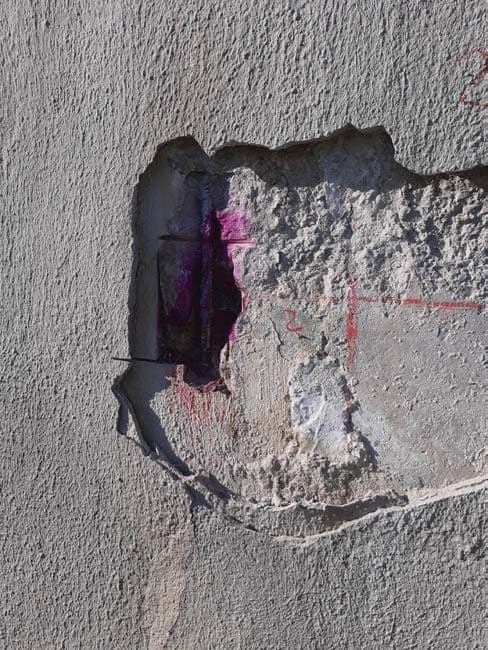
Test opening in a digester's concrete wall with exposed reinforcement and phenolphthalein
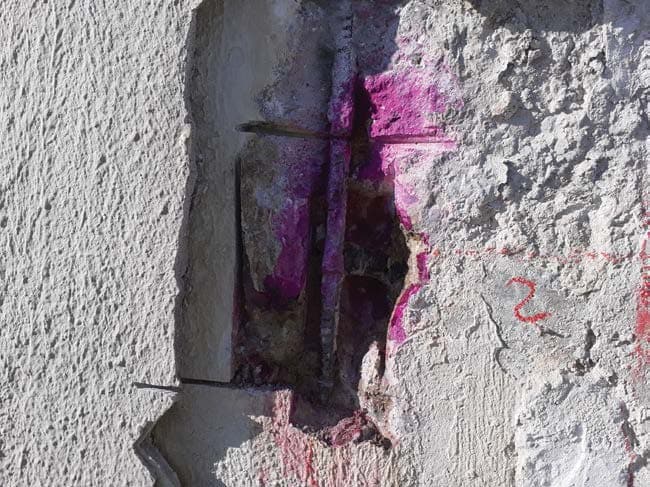
Test opening in the wall: phenolphthalein marks concrete that is still alkaline; where it does not stain, carbonation has already arrived.
Project data

Technical sheet

Instalación
Wastewater treatment plant (WWTP)
Elementos
Two cylindrical reinforced concrete digesters, 23 m internal diameter and 40 cm walls
Diagnóstico
Test openings, phenolphthalein and rebar scanning: carbonation down to the reinforcement and a leaking construction joint
Reparación
Passivating primer with corrosion inhibitor and R4 structural repair mortar (EN 1504-3)
Perimeter joint
Joint regeneration and low-pressure injection with two-component polyurethane resin
Protección
Elastic anti-carbonation coating outside and chemical-resistant epoxy inside
Sistemas
Master Builders range (MasterEmaco, MasterInject, MasterProtect, MasterSeal), now part of the Sika group
Año
2020 project

Repairing the digesters of a wastewater plant in Girona

The two sludge digesters at a wastewater treatment plant in Girona, in service since the mid-1980s, had carbonation already at the reinforcement and a poorly executed perimeter construction joint, about three metres up, which kept leaking despite earlier repairs. For data protection reasons we do not name the operator.

Diagnosis before repair

With the tanks full of sludge, we carried out test openings, a phenolphthalein carbonation depth test and radar scanning of the reinforcement. Conclusion: reinforcement still in good condition, but without the concrete's alkaline protection; the right moment to act before corrosion starts.

How we work: from enquiry to handover

On every project we take on whatever is needed, a single phase or the whole process:

  1. Technical enquiry. We receive photos, drawings and the problem, and reply with an initial assessment.
  2. Consulting and diagnosis. Site visit, testing and choice of the right system for the substrate and use.
  3. Specification and fixed-price quote for materials and execution.
  4. Execution by an approved applicator from our network, trained and approved by the system manufacturer.
  5. Site management and quality control: substrate, moisture, thickness, curing and detailing.
  6. Finishing, final documentation and handover.

Double guarantee: the manufacturer backs that the installed system meets its standards, and we guarantee it has been applied correctly. That is why our repairs, waterproofing and floors last for years.
Step by step

How the digesters of a wastewater plant are repaired

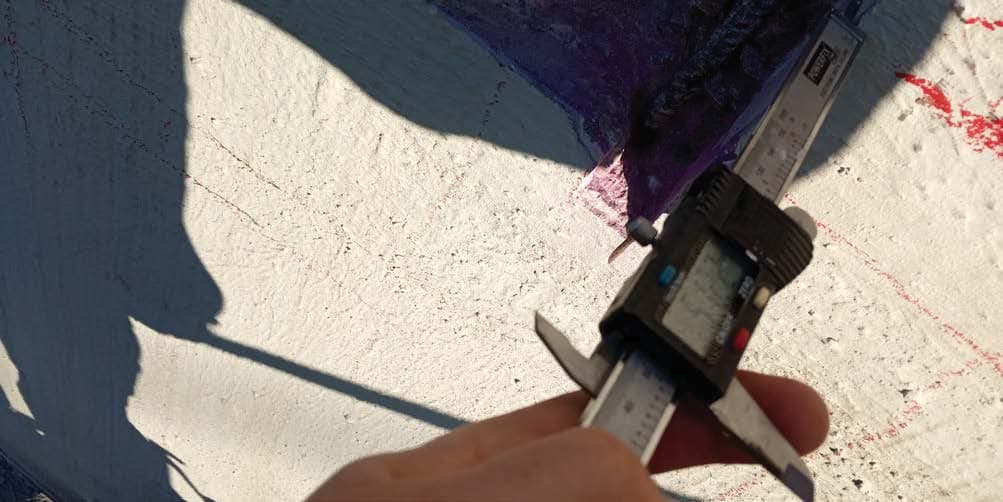
  1. Measuring carbonation depth with a caliper in a digester's concrete
    Step 1

    Diagnose the concrete

    Test openings, carbonation depth with phenolphthalein and radar scanning of the reinforcement.

  2. Step 2

    Empty, make inert and clean

    The digesters are emptied, made inert and cleaned before work starts inside.

  3. Test opening in a digester's concrete wall with exposed reinforcement and phenolphthalein
    Step 3

    Repair the concrete

    Concrete removal, passivating primer with corrosion inhibitor and R4 structural repair mortar (EN 1504-3).

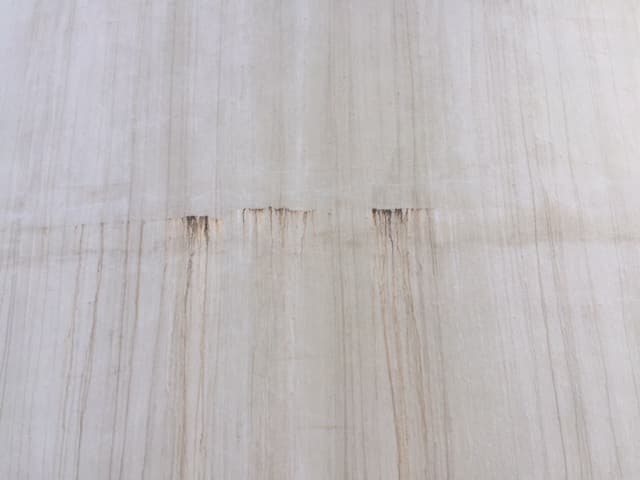
  4. Wastewater digester wall with stains at the perimeter construction joint
    Step 4

    Inject the perimeter joint

    The construction joint is regenerated and injected at low pressure with two-component polyurethane resin.

  5. Step 5

    Protect the concrete

    Elastic anti-carbonation coating outside and chemical-resistant epoxy inside.

On-site record

Project photos

Carbonation front revealed with phenolphthalein in a concrete test opening
Carbonation front revealed with phenolphthalein.
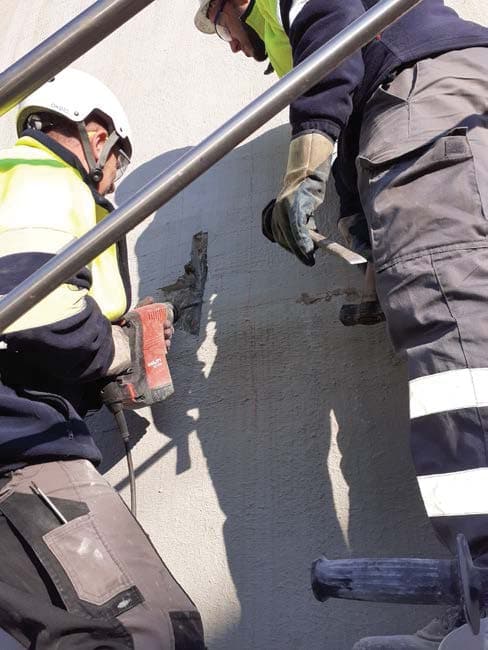
Technicians testing the wall of a wastewater digester
Testing the wall before defining the repair.
Common questions

Frequently asked questions

How do you know if carbonation has reached the reinforcement?

With a test opening and phenolphthalein: concrete that is still alkaline turns pink and carbonated concrete does not. The depth is measured and compared with the cover.

Why do digesters leak through the construction joint?

Because the joint between concrete pours was not properly sealed at the time. It has to be regenerated and injected; a surface coating is not enough.

What protects the concrete of a digester?

An anti-carbonation coating outside and a chemical-resistant one inside, against gas and sludge.

Who carries out the work?

An approved applicator from our network, trained and approved by the system manufacturer. We handle the consulting, the specification and site management, and we guarantee the system is properly applied.

Do you work outside Catalonia?

Yes. We work throughout Spain, especially in Catalonia, the Valencia region and Aragon, with approved applicators in each area.

Do you manage wastewater plants, tanks or sewers?

We diagnose the concrete, specify the repair and protection, an approved applicator carries it out and we manage the work with the facility in service wherever possible.

Request a technical study
Call WhatsApp Request a quote